


EMDR intensives and EMDR therapy offer two ways of working through the same process, with the main difference being how the time is structured. One brings longer, focused sessions, while the other moves at a steady weekly pace.
You might find yourself wondering which approach feels right. Is it better to stay with the work in a shorter, concentrated period, or to move through it gradually over time?
There isn’t a right or wrong choice. What tends to matter more is what feels sustainable, supportive, and aligned with how you want to move through the process.
This guide walks through how EMDR intensives and weekly sessions compare, and how to choose the approach that fits you best.
What are EMDR intensives?

EMDR intensives are extended EMDR sessions designed to help process trauma in a shorter, more concentrated period of time.
Structure
Sessions typically involve working together for about 6 hours a day across 2 to 5 days. They often begin in the morning and continue through the afternoon with breaks as needed, allowing the work to stay continuous.
In many intensive formats, the work centers on one memory at a time, often focusing on working through memories from more complex trauma for the day so it can be processed with more focus and attention.
Benefits
EMDR intensives can help in a few important ways:
- More time is spent processing, rather than reopening things each session
- More can be worked through in a shorter period of time
- Greater sense of safety as the client deals with more traumatic memories and doesn’t have to drive home or deal with every day responsibilities
- Less interruption between sessions, which can help you stay with the process
- Fewer sessions may be needed overall
- Space to rest and reflect between longer sessions
This can make the work feel steadier and easier to stay connected to from one session to the next.
Who it is best for
EMDR intensives are especially helpful for people working through complex or layered trauma, including long-standing grief, relational wounds, or experiences that don’t trace back to a single event . Intensives are also best for those who prefer to work through things in a more concentrated way.
They are also a good fit for those who want to step away from their daily routine and fully focus on their healing for a short period of time.
Costs
Costs are structured per day. A half-day intensive is typically around $750 on weekdays and $1,000 on weekends. Full-day sessions are about $1,500 per day or $2,000 on weekends. Lodging at the retreat space is available at approximately $125 per night.
What do EMDR sessions look like?

EMDR sessions follow a steady, guided process where you focus on specific memories while staying grounded and supported throughout.
Structure
Sessions typically last 50 to 90 minutes and take place once a week. Time is spent identifying what you want to work on, building stability, and then using bilateral stimulation, such as eye movement, tapping, or sound, while briefly focusing on parts of a memory.
Benefits
Meeting regularly in shorter sessions allows for:
- A steady pace that gives you time to adjust between sessions
- Space to reflect on what comes up outside of therapy
- Support while working through more complex or layered experiences
- Integration of changes into daily life over time
- Flexibility to move forward at a comfortable rhythm
This approach allows the work to build gradually, with time between sessions to process and settle.
Who this is best for
EMDR therapy is often a good fit for individuals who prefer a slower pace. . It can also be helpful when ongoing support is needed alongside day-to-day responsibilities.
Costs
Sessions are typically paid per visit and may range from $160 to $240, depending on the length of the session. A superbill may be provided if you plan to seek out-of-network reimbursement.
Deciding which one is best for you
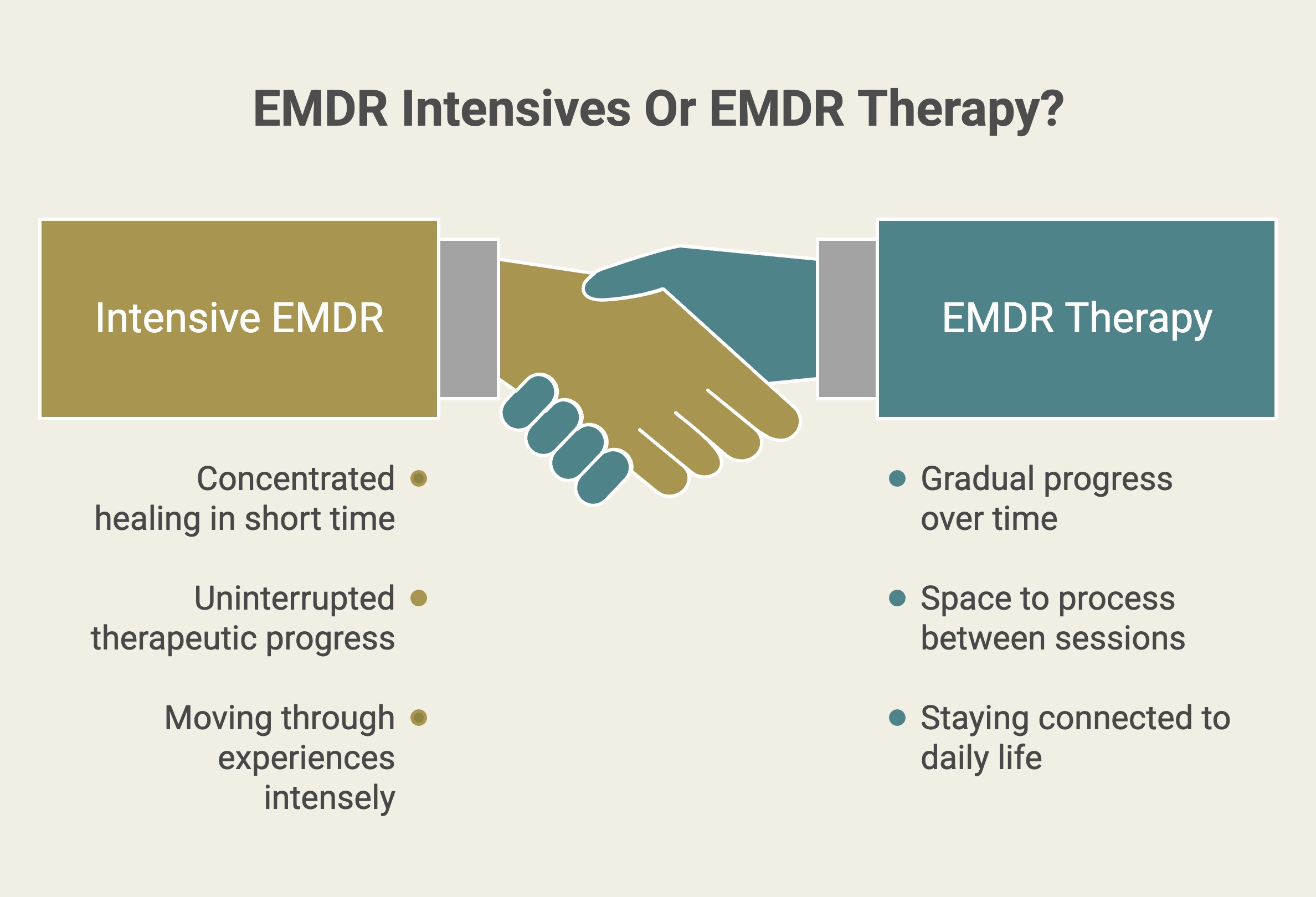
EMDR intensives are best when you want to focus deeply in a shorter period of time, while weekly EMDR sessions are better when you prefer a steady pace with time between sessions.
Intensives are a better fit if you want to stay with the work without stopping and restarting each week. They can be helpful when you want to move through traumatic experiences in a more concentrated way.
Weekly EMDR therapy sessions are a better fit if you want time between sessions to reflect and adjust. This can be helpful when you need to stay connected to your daily routine while in therapy.
The decision often comes down to what feels realistic for you right now, both in terms of time and how you want to move through the process.
Find your way forward at Back Porch Counseling
There is not one way this work has to look. Both EMDR intensives and weekly EMDR therapy can be helpful, depending on what feels right for you and where you are right now.
You may find that one approach fits better than the other, or that your needs shift. What matters most is having a place to begin, and a way to work through what has been difficult in a way that feels steady and supported.
If you are unsure which option makes sense for you, we can take the time to talk it through together and find what feels like the right next step. Book a free consultation.
Frequently asked questions
Do EMDR intensives work?
Yes, EMDR intensives can help you work through trauma more quickly by staying with the process for longer periods of time. This focused approach allows your mind to process more without having to pause between sessions. Research shows they are just as effective as weekly sessions and relief is often felt sooner with intensives. Additionally, because of the sense of safety felt in a retreat setting, you may be able to go into deeper memories with greater ease.
How to prepare for EMDR intensive?
Preparation involves getting clear on what you would like to work on and making space in your schedule to focus on the process. It can also help to plan for rest, since the work can feel both meaningful and tiring.
How many sessions of EDMR to see results?
Some people notice changes within a few sessions, while others may need more time, depending on what they are working through. The pace can vary, but the focus is on allowing things to shift in a way that feels steady.
Is EMDR intensive better than weekly therapy?
EMDR intensives are not better, it’s just different in how the work is paced. Some people prefer staying with the process in longer sessions, while others benefit from having time between weekly sessions.
Can EMDR help if I don’t remember everything clearly?
Yes, EMDR can still be helpful even if parts of the memory feel unclear or incomplete. The process does not rely on full recall, but on how the experience is held in your mind and body.
One thought on “EMDR Intensives vs EMDR Therapy”