


Seven trauma therapies worth comparing are EMDR therapy (Eye Movement Desensitization and Reprocessing), Cognitive Processing Therapy (CPT), Prolonged Exposure (PE), Cognitive Therapy for posttraumatic stress disorder (PTSD), Narrative Exposure Therapy (NET), Written Exposure Therapy (WET), and Present-Centered Therapy (PCT). Each uses a different approach, with varying levels of research support.
These therapies address painful memories, negative thoughts, and daily challenges. Much of the research discussed below focuses on PTSD, so the findings shouldn’t be assumed to apply equally to every trauma-related concern.
Some approaches process traumatic memories directly, while others focus on beliefs or current difficulties.
What makes trauma therapy evidence-based?

Evidence-based trauma therapy draws on the best available research, a clinician’s expertise, and your needs and preferences. Researchers test treatments for specific conditions, compare outcomes, and assess potential harms. Expert panels review this evidence when developing treatment guidelines.
The 2023 clinical practice guideline from the U.S. Departments of Veterans Affairs and Defense (VA/DoD) strongly recommends PE, CPT, and EMDR for PTSD.
Research is only one part of good care. Your therapist also considers your experiences, preferences, and priorities when choosing an approach with you.
7 evidence-based trauma therapies and how they work
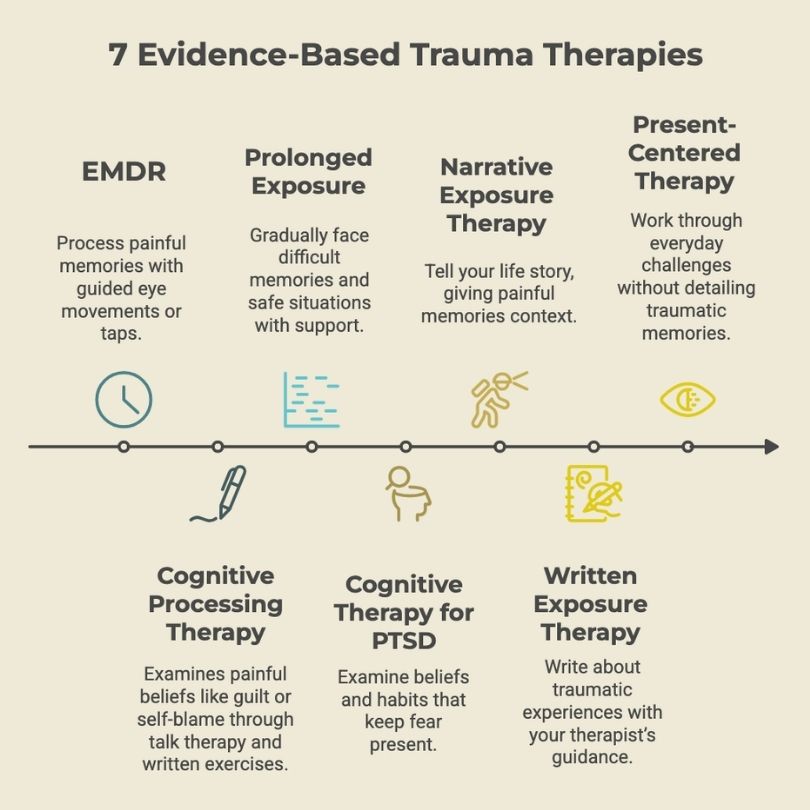
The seven therapies below differ in method and in how much research supports them. Certain approaches work directly with the traumatic memory, while others focus on beliefs, personal story, or current problems.
1. Eye Movement Desensitization and Reprocessing (EMDR)
EMDR therapy helps people process distressing memories using guided bilateral stimulation, such as side-to-side eye movements or alternating taps. This approach can help reduce the emotional distress associated with traumatic experiences.
Sessions follow eight structured phases that include preparation, memory processing, and reassessment. You work with a trained therapist who helps you stay grounded throughout treatment.
Research support: EMDR is strongly recommended for PTSD. Clinical trials support its effectiveness, but the evidence for other conditions is less established.
2. Cognitive Processing Therapy (CPT)
CPT is a structured talk therapy that helps you work through painful beliefs that can follow trauma, such as guilt, self-blame, or the feeling that the world isn’t safe anymore.
You and your therapist examine these beliefs in sessions, and you also complete written exercises. Those exercises help you see what happened from a more balanced view.
Research support: CPT is strongly recommended for PTSD, and substantial evidence supports its effect on trauma-related symptoms.
3. Prolonged Exposure (PE)
Prolonged Exposure guides people to gradually face trauma-related memories and safe situations they have avoided because of fear. Your therapist guides you through planned exercises, including recalling difficult experiences and gradually returning to activities that have become linked to distress.
Research support: PE is strongly recommended for PTSD. Studies show that this structured approach can reduce avoidance and other PTSD symptoms.
4. Cognitive Therapy for PTSD
Cognitive Therapy for PTSD focuses on the beliefs and interpretations that keep a person feeling threatened after a traumatic experience. For example, someone who survived a car accident may keep believing that everyday travel is unsafe. Therapy helps examine these interpretations and address behaviors that maintain fear.
Research support: The 2023 VA/DoD guideline suggests Ehlers and Clark’s Cognitive Therapy for PTSD, with a weaker recommendation than CPT, EMDR, or PE.
5. Narrative Exposure Therapy (NET)
Narrative Exposure Therapy helps people place traumatic experiences within the broader story of their lives.
Your therapist guides you through a chronological account of important events, including painful experiences and meaningful memories. NET was designed for people who have lived through repeated trauma, such as war and displacement.
Research support: Recommendations differ by guideline. The American Psychological Association suggests NET for PTSD, while the 2023 VA/DoD guideline found insufficient evidence to recommend for or against it.
6. Written Exposure Therapy (WET)
Written Exposure Therapy uses guided writing sessions to help people engage with traumatic memories in a structured setting. Treatment typically involves five sessions. You write about the traumatic experience and your thoughts and feelings, with guidance from a therapist.
Research support: The 2023 VA/DoD guideline suggests WET for PTSD. It offers a shorter treatment format backed by clinical research.
7. Present-Centered Therapy (PCT)
Present-Centered Therapy addresses the everyday difficulties that can follow trauma without requiring detailed processing of traumatic memories. Sessions focus on current concerns, such as relationship problems, emotional distress, and challenges with daily functioning. Your therapist helps you develop practical ways to manage these difficulties.
Research support: The 2023 VA/DoD guideline suggests PCT as a non-trauma-focused option. Trauma-focused therapies generally produce greater reductions in PTSD symptoms.
How to compare trauma therapy approaches

You can compare trauma therapies by looking at your symptoms, the treatment method, the research behind it, and the session format. The distinctions below can help you prepare questions for a therapist; more than one approach may address the same concern.
- Distressing memories: EMDR and PE work directly with traumatic memories, using different techniques.
- Guilt or negative beliefs: CPT and Cognitive Therapy for PTSD address unhelpful thoughts.
- Repeated trauma: NET places experiences within your life story.
- Writing preference: WET uses structured writing exercises.
- Daily challenges: PCT focuses on current difficulties without directly processing trauma.
You’ll also want to consider the session format. Weekly appointments provide steady support, while intensives offer concentrated treatment time. To see how these formats differ, read about EMDR intensives and weekly therapy. Your therapist can assess your needs and recommend an approach.
Evidence-based trauma therapy in Huntsville

For evidence-based trauma therapy in Huntsville, look for a licensed counselor trained in research-supported methods. Jan Owen, MA, LPC, NCC, is a licensed professional counselor and certified EMDR therapist in Huntsville, AL. Her training and her own experience with loss shape how she works with trauma, grief, and life transitions.
Jan offers EMDR intensives at her Huntsville office and at The Sanctuary, a private retreat cabin near Lake Guntersville. Intensives aren’t the right fit for everyone, so Jan bases treatment on your individual needs.
Find evidence-based trauma therapy in Huntsville
Choosing a therapist is a personal decision. Care should move at a pace that feels right for you.
Your first consultation lets you explain what brings you in, ask how EMDR works, and discuss how an intensive might fit your needs. Book a free consultation to start that conversation.
FAQs about evidence-based trauma therapy
Which evidence-based therapies treat trauma?
EMDR, Cognitive Processing Therapy (CPT), and Prolonged Exposure (PE) have strong research support for PTSD. The 2023 VA/DoD guideline also suggests Cognitive Therapy for PTSD, Written Exposure Therapy (WET), and Present-Centered Therapy (PCT). Recommendations for Narrative Exposure Therapy (NET) differ across guidelines.
What does evidence-based therapy mean?
Evidence-based therapy uses methods that scientific studies have tested for a specific condition. Treatment decisions combine that research, the clinician’s experience, and your preferences. How well a treatment works can differ depending on the condition.
Is EMDR really evidence-based?
Yes. Clinical studies support EMDR, and the 2023 VA/DoD guideline strongly recommends it for PTSD. In EMDR, you recall a distressing memory while following guided back-and-forth eye movements or taps. Evidence for other conditions is less established.
Which trauma therapies have the strongest evidence for PTSD?
The 2023 VA/DoD guideline gives its strongest psychotherapy recommendations to EMDR, Cognitive Processing Therapy, and Prolonged Exposure. Research has not shown that one treatment works best for everyone. Your symptoms, your preferences, and the trained clinicians near you all shape which option makes sense.
How do I know which trauma therapy is right for me?
Start with your symptoms, your comfort with memory-focused work, and the session schedule you can keep. Your licensed therapist can explain which approaches suit your situation, assess your needs, and help you choose. You should not feel rushed into starting.