Who Is the Best EMDR Therapist in Huntsville, Alabama?

Who Is the Best EMDR Therapist in Huntsville, Alabama?

There isn’t one objectively best EMDR therapist for everyone. The right choice depends on your treatment goals, the concerns you’d like to address, and the type of support that fits you best. Some therapists focus on trauma or grief, while others provide broader counseling services or concentrated EMDR intensives instead of traditional weekly sessions.

Provider profiles can be difficult to compare because many list similar credentials and approaches. Looking closely at each therapist’s experience, specialties, treatment formats, and setting can make the differences clearer.

This guide compares 5 EMDR therapists and practices in Huntsville, Alabama. Understanding how EMDR therapy works can also help you evaluate your options and ask more informed questions before beginning treatment.

How these Huntsville EMDR providers were evaluated

The therapists and practices in this list were compared using publicly available information from their official websites and professional profiles. The evaluation considered:

  • Professional licensure
  • EMDR training or certification
  • Relevant clinical specialties
  • Therapy format and treatment setting
  • The needs each provider may be best equipped to address

EMDR training and EMDR certification aren’t interchangeable. Before choosing a provider, ask what training they completed, whether they hold a current certification, and how regularly they use EMDR with concerns similar to yours.

5 EMDR therapists and practices in Huntsville to consider

These Huntsville EMDR providers vary in their specialties, treatment formats, and services. The numbering is for organization and doesn’t represent an overall clinical ranking.

1. Jan Owen, Back Porch Counseling

Jan Owen provides counseling for grief, trauma, anxiety, depression, panic, and major life transitions through Back Porch Counseling. Clients can choose traditional therapy sessions or explore a more concentrated EMDR intensive format based on their needs and readiness.

Credentials

  • Licensed Professional Counselor and National Certified Counselor
  • Trained and certified in EMDR
  • Trained and certified in bereavement and life-transition counseling through the Center for Loss and Life Transition

Approach

  • Provides grief counseling, trauma therapy, EMDR, and standard counseling sessions
  • Offers EMDR intensives ranging from shorter sessions to multi-day treatment
  • Provides intensive treatment at her Huntsville office and The Sanctuary near Lake Guntersville, depending on the format

Best fit

  • Adults seeking grief or trauma therapy with standard and intensive EMDR options
  • Huntsville-area adults seeking care at 475 Providence Main Street, Suite 303C, and clients traveling to North Alabama for retreat-style treatment near Lake Guntersville

2. Melissa Vann, LPC

Melissa Vann is a Huntsville-based Licensed Professional Counselor who works with adults experiencing PTSD, complex trauma, dissociation, grief, depression, anxiety, stress, and related concerns.

Credentials

  • Licensed Professional Counselor with more than 20 years of counseling experience
  • Trained and certified in EMDR and a member of the EMDR International Association
  • Trained in Internal Family Systems therapy

Approach

  • Integrates EMDR and Internal Family Systems concepts according to each client’s needs
  • Provides individual counseling to adults
  • Works with trauma, PTSD, dissociation, anxiety, depression, grief, stress, and career concerns

Best fit

  • Adults interested in an approach informed by both EMDR and Internal Family Systems
  • Huntsville-area adults seeking individual counseling near Providence Main Street

3. Holleigh Woodward Counseling

Holleigh Woodward is a Huntsville-based Licensed Professional Counselor who works with adults experiencing trauma, anxiety, depression, insomnia, and related concerns.

Credentials

  • Licensed Professional Counselor with specialized EMDR training
  • Certified in Cognitive Behavioral Therapy for Insomnia, or CBT-I

Approach

  • Uses EMDR, CBT-I, Brainspotting, Cognitive Behavioral Therapy, Acceptance and Commitment Therapy, and strengths-based counseling
  • Treats trauma-related concerns, anxiety, depression, and sleep difficulties
  • Offers in-person and telehealth appointments

Best fit

  • Adults seeking trauma therapy with additional support for insomnia or disrupted sleep
  • Clients looking for in-person care in Huntsville or telehealth appointments

4. Thriveworks Counseling & Therapy Huntsville

Thriveworks Counseling & Therapy Huntsville is a larger, multi-provider practice offering multiple counseling formats and specialties. EMDR is listed among its Huntsville services, although treatment methods and qualifications vary by clinician.

Credentials

  • Multi-provider practice with licensed mental health professionals from different clinical backgrounds
  • Lists EMDR among the approaches available through its Huntsville practice
  • Features Andy Markham, LPC, whose profile states that he has more than 18 years of experience and uses EMDR, CBT, and family-systems approaches

Approach

  • Offers individual, child, teen, couples, and family services
  • Provides in-person and online counseling
  • Accepts many major insurance plans, with EMDR availability and training varying by clinician

Best fit

  • Huntsville clients who want a larger provider network, multiple scheduling options, or online counseling
  • Individuals and families looking for a practice that accepts a broad range of insurance plans

5. Garrett Counseling

Garrett Counseling is a multi-location Alabama practice that has served children, adolescents, and adults since 2009. Its services include traditional counseling, EMDR, play therapy, couples counseling, and family counseling.

Credentials

  • Multi-provider Alabama counseling practice operating since 2009
  • Lists EMDR and play therapy among its services
  • Works with children, adolescents, adults, couples, and families

Approach

  • Provides counseling for trauma, anxiety, depression, ADHD, relationship concerns, and other mental health needs
  • Offers in-person services at multiple Alabama locations, including Huntsville, as well as telehealth
  • Displays Alabama Medicaid, Blue Cross and Blue Shield, ALL Kids, and Aetna insurance information, with coverage and EMDR availability varying by clinician

Best fit

  • Huntsville families seeking counseling services for children and adults through one practice
  • Clients who want access to multiple providers, treatment specialties, or telehealth services

Questions to ask before choosing an EMDR therapist

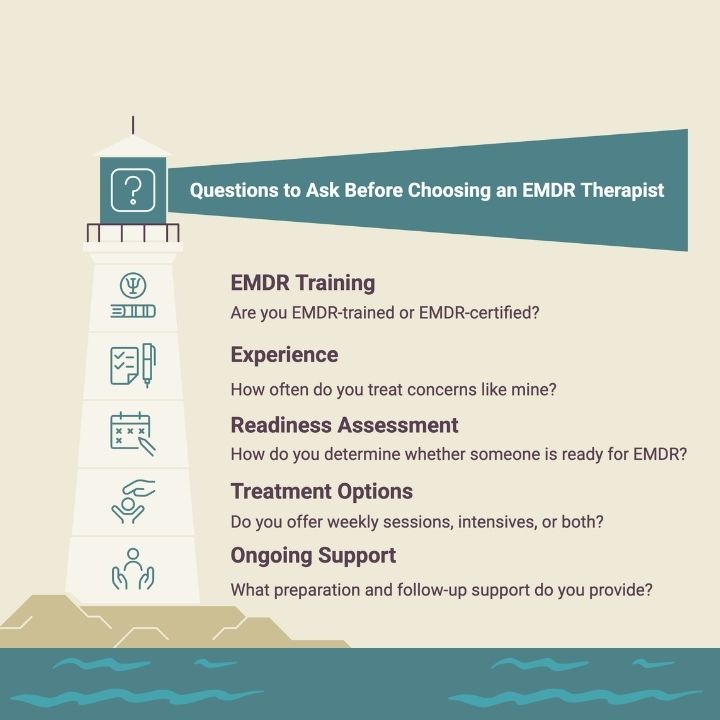
Infographic showing key questions to ask before choosing an EMDR therapist.

The best questions to ask an EMDR therapist focus on qualifications, relevant experience, readiness assessment, treatment format, and follow-up care. Their answers can give you a clearer picture of what to expect before beginning therapy.

  • Are you EMDR-trained or EMDR-certified?
  • How often do you use EMDR with concerns like mine?
  • How do you determine whether someone is ready for EMDR?
  • Do you provide weekly sessions, EMDR intensives, or both?
  • What preparation and follow-up support do you provide?

Credentials matter, but the therapeutic relationship matters, too. You should feel respected, informed, and able to ask questions without being rushed into trauma processing before you’re ready.

Talk with Jan Owen about EMDR therapy in Huntsville

Choosing an EMDR therapist takes more than comparing credentials or reading biographies. A direct conversation can help you understand how a therapist approaches EMDR, what treatment may involve, and whether their experience aligns with the concerns you want to address.

If you’re considering an EMDR intensive, Jan can answer your questions about preparation, scheduling, treatment format, and what to expect. You can request a free 20-minute consultation to discuss whether an intensive may fit your needs.

Frequently asked questions

How can you tell if an EMDR therapist is good?

Look for appropriate licensure, recognized EMDR training, relevant clinical experience, and a clear readiness assessment. A good EMDR therapist explains the process, potential discomfort, preparation, and follow-up; answers questions directly; and doesn’t rush trauma processing.

What kind of trauma is EMDR best for?

EMDR has its strongest evidence for PTSD and trauma-related symptoms. It may be used after single-event or repeated trauma, including accidents, abuse, violence, medical trauma, and traumatic loss, but a clinical assessment should determine whether it’s appropriate for your needs.

When is EMDR not a good idea?

EMDR may not be appropriate to start during an active crisis, an immediate safety concern, or severe instability. A clinician may recommend stabilization, grounding skills, medical care, crisis support, or another treatment before beginning trauma processing.

How long does EMDR take to heal trauma?

There’s no fixed timeline. The National Center for PTSD describes EMDR for PTSD as commonly involving weekly 50- to 90-minute sessions over approximately three months, but treatment may be shorter or longer depending on your history, symptoms, goals, and response.

How can you tell if EMDR is working?

EMDR may be working when traumatic memories cause less distress and symptoms interfere less with daily life. Signs can include fewer emotional reactions, less avoidance, better sleep, healthier beliefs, and a greater ability to recall an experience without feeling as though it’s happening again.

What to Expect From EMDR Intensives in Huntsville, AL

EMDR intensives provide extended, focused therapy over a half-day, full-day, or several consecutive days. The process begins with a consultation and intake, then follows a personalized plan that may include preparation, EMDR processing, grounding, breaks, and follow-up planning.

Back Porch Counseling offers EMDR intensives in Huntsville ranging from a half day to two days, along with longer retreat-style options at The Sanctuary near Lake Guntersville. This guide explains how the intensive format differs from weekly therapy and what happens before, during, and after treatment.

How do EMDR intensives differ from weekly therapy?

EMDR intensives reserve more time for treatment. Instead of meeting for a standard weekly session, you work with your therapist for a half day, full day, or across consecutive days.

The underlying EMDR therapy process remains structured. The extended format allows more time for preparation, processing, grounding, and reflection without waiting a full week between sessions.

What does research say about intensive trauma treatment?

EMDR has strong guideline support as a treatment for PTSD. Evidence for intensive formats is more limited, and the research cited here does not evaluate a private, EMDR-only intensive.

A recent uncontrolled study analyzed 73 patients with PTSD who completed a four-day remote program combining EMDR, prolonged exposure, physical activity, and psychoeducation. PTSD symptoms decreased after treatment and remained lower at the six-month follow-up.

Because the study combined several treatments and didn’t include a control group, it cannot show that EMDR alone caused the improvements or predict the outcome of a private EMDR intensive.

What happens before your EMDR intensive

A consultation and intake come first. These steps help determine if an intensive is appropriate and which format may best fit your needs.

Consultation, intake, and treatment goals

You can begin with a free 20-minute consultation to ask questions and discuss what you hope to address. After deciding to move forward, a 90-minute intake provides time to review your history, current concerns, coping resources, and treatment goals.

You won’t necessarily need to describe every detail of a distressing experience. The intake provides the information needed to assess readiness, identify possible treatment targets, and plan the intensive carefully.

You may also practice grounding or emotional regulation skills before beginning focused processing.

Choosing the schedule and setting

The length and location of your intensive will depend on your goals and clinical needs.

Shorter EMDR intensives, ranging from a half day to two days, may be held at the Huntsville office or The Sanctuary. Longer intensives, generally lasting two to five days, are available at The Sanctuary near Lake Guntersville.

Grief-focused retreats at The Sanctuary typically last two to three days. The schedule is discussed during intake rather than selected through a one-size-fits-all package.

What to expect during an EMDR intensive

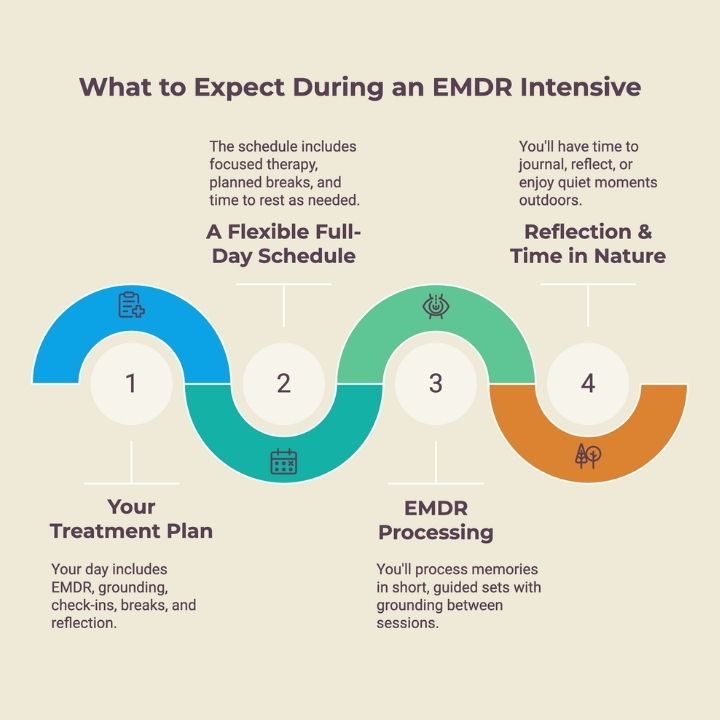
An EMDR intensive combines focused therapy with regular opportunities to pause, ground, and reset.

Depending on your treatment plan, the intensive may include:

  • Reviewing your goals, readiness, and current level of distress
  • EMDR processing in short, guided sets
  • Grounding, check-ins, and emotional regulation
  • Planned breaks and time for lunch
  • Journaling, creative activities, remembrance work, or time in nature

Not every intensive includes every element. The structure is adjusted around your needs and responses throughout the day.

A flexible full-day schedule

For retreat-style intensives, a typical day begins around 9 a.m., includes an hour for lunch around noon, and ends around 4 p.m. Breaks are taken as needed, and the amount of active therapy time may vary.

The schedule remains flexible. More time can be added for settling, reflecting, or simply taking a breath when needed.

EMDR processing, grounding, and breaks

During EMDR processing, you briefly bring an upsetting memory and its related thoughts, emotions, or physical sensations to mind. At the same time, you attend to bilateral stimulation, such as side-to-side eye movements, tapping, or alternating tones.

Processing happens in short sets. Between sets, the therapist pauses to ask what you notice, assess your distress, and help you remain connected to the present.

The goal is to reduce the distress and unhelpful beliefs associated with the memory, not erase the memory itself. Researchers continue to study exactly how EMDR produces change.

Reflection and time in nature

At The Sanctuary, your treatment plan may include quiet reflection, creative activities, remembrance work, or time outdoors.

You may have space to journal, sit on the porch with coffee or tea, or rest while looking out over the woods. These moments provide a gentler transition between periods of focused clinical work.

What happens after an EMDR intensive?

Before the intensive ends, you and Jan can review what you noticed, use grounding strategies, and discuss possible next steps.

Focusing on distressing memories can feel uncomfortable, so it may help to leave room for rest afterward. Ask which reactions to watch for, which grounding strategies to use, and when to reach out for additional support.

Optional follow-up session

A 50-minute follow-up session is available if desired. This appointment can be used to review changes in symptoms, discuss how the work is affecting daily life, and decide if additional treatment would be helpful.

Continuing therapy when needed

An intensive doesn’t automatically replace ongoing therapy. Some people may not need immediate continued treatment, while others benefit from regular counseling afterward.

Ongoing support may be especially helpful when someone is navigating prolonged grief, multiple losses, complex trauma, or continuing life stress. The appropriate next step should be based on clinical needs rather than a preset timeline.

Is an EMDR intensive right for you?

An EMDR intensive may be worth considering if you prefer extended treatment time, have a specific concern you want to address, or find weekly sessions difficult to schedule.

It may also appeal to people who want fewer interruptions between preparation, processing, and reflection. You can explore additional signs that an EMDR intensive may fit your needs before scheduling a consultation.

However, an intensive isn’t appropriate for everyone. Some people need additional stabilization, preparation, or support before beginning extended trauma-focused work.

EMDR has its strongest research support for PTSD. Clinicians may also use it for grief-related distress and other disturbing life experiences when appropriate, but the strength of evidence varies by condition. An intake is necessary to determine if EMDR and an intensive format fit your circumstances.

Talk with Back Porch Counseling about an EMDR intensive

Jan Owen, LPC, NCC is trained and certified in EMDR and has specialized training and certification in bereavement and life-transition counseling.

During the consultation, you can discuss weekly EMDR therapy, a shorter intensive in Huntsville, or a retreat-style experience at The Sanctuary. Reaching out doesn’t commit you to treatment.

You can request a free 20-minute consultation to ask questions and discuss how an EMDR intensive may fit your needs.

Frequently asked questions

How do EMDR intensives work?

EMDR intensives extend treatment beyond a standard weekly session. They may last a half day, full day, or multiple consecutive days, with processing, grounding, breaks, and reflection built into the schedule.

Are EMDR intensives safe?

EMDR intensives can be appropriate for carefully screened clients, but they aren’t risk-free or suitable for everyone. Trauma-focused work may cause emotional discomfort during or after treatment, making intake, preparation, pacing, and grounding essential.

How long does an EMDR intensive last?

At Back Porch Counseling, shorter EMDR intensives range from a half day to two days, while longer intensives generally last two to five days. Grief-focused retreats typically last two to three days, with a typical full day running from about 9 a.m. to 4 p.m.

How should I prepare for an EMDR intensive?

Complete the intake honestly, discuss your concerns and goals, and practice any grounding skills provided by your therapist. Arrange meals, transportation, and a lighter schedule after the intensive when possible.

What should I avoid after an EMDR intensive?

There’s no universal list of activities everyone must avoid. Follow your therapist’s aftercare plan, keep the rest of your day light when possible, and avoid driving if distress or fatigue makes it unsafe.

How Long Does an EMDR Intensive Take?

How long does an EMDR intensive take? It’s one of the most common questions people ask when considering a more focused therapy format in Alabama.

EMDR intensives often last between 3 and 6 hours per day, with some people choosing one-day sessions while others participate across multiple consecutive days. The timeline usually depends on what someone hopes to process and how much support feels manageable emotionally.

Below is what can affect the length of an EMDR intensive and what the process may look like.


The typical length of an EMDR Intensive

Most EMDR intensives last between 3 and 6 hours per day with breaks included throughout the session. Some people complete a shorter half-day intensive lasting around 3 hours, while others participate in full-day sessions lasting 6 hours or more.

The number of days also depends on what someone hopes to process. A single distressing experience may take 1 to 2 days of focused work, while more complex trauma, grief, or long-term emotional stress may require 3 to 5 consecutive days.

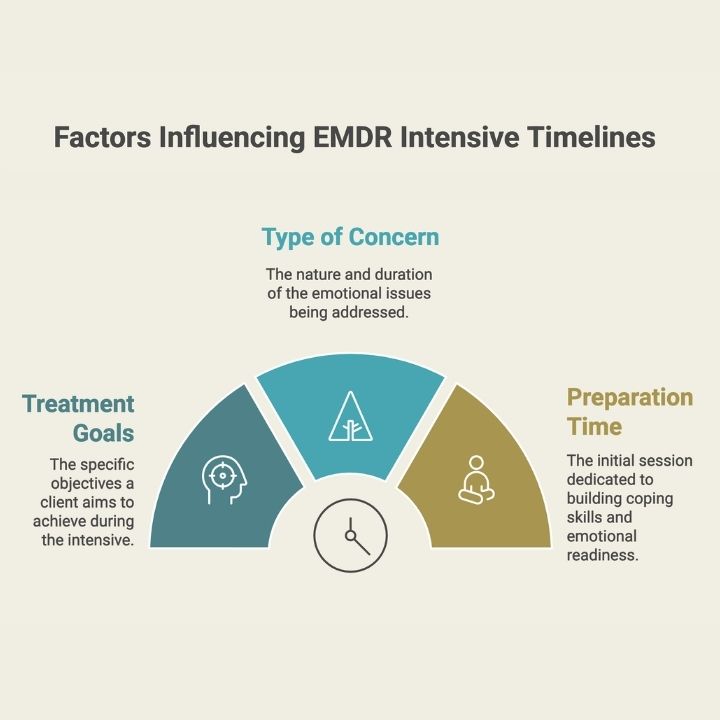
What changes the timeline

The amount of time someone needs can vary from one person to another depending on their emotional history, treatment goals, and the experiences being processed.

Your goals for the intensive

Some people focus on one stressful event or recent experience, while others want support around years of grief, trauma, or emotional overwhelm. More layered emotional concerns often require more time and a slower pace.

The type of concern being treated

Single-incident trauma, such as accidents or medical events, may sometimes take less time to process than long-term trauma or repeated emotional stress.

Concerns connected to childhood trauma, complicated grief, panic symptoms, or emotional exhaustion often require a slower pace and more emotional recovery time.

How much preparation is needed

Most intensives begin with a preparation session lasting about 90 minutes to 2 hours before deeper processing starts. This time helps clients build grounding skills and prepare emotionally for longer therapy sessions.

What happens during the intensive process

EMDR intensives usually include grounding exercises, trauma processing, emotional support, and breaks for rest throughout the session. Clients remain awake, aware, and able to communicate with the therapist during the entire process.

Sessions may also include breaks for meals, hydration, stretching, journaling, or emotional rest based on the length of the intensive.

Research on intensive trauma-focused therapy has also shown that longer treatment formats may help people stay more connected to the therapeutic process.

One-Day vs. multi-day EMDR Intensives

One-day EMDR intensives usually focus on one specific experience or emotional concern, while multi-day intensives create more time for deeper emotional processing.

Shorter formats may feel more manageable for people balancing demanding schedules or trying intensive therapy for the first time. 

Multi-day intensives are often used for trauma, grief, repeated stress, or long-standing emotional patterns that may need additional support and processing time.

How to know which format fits your needs

The best intensive format usually depends on how emotionally activated someone feels, the type of experiences they want to process, and how much recovery time they can allow afterward.

Some people feel more comfortable starting with a shorter intensive before deciding if they want additional sessions later. 

Others reach a point where they need more intentional space to slow down, process difficult emotions, and experience some of the benefits EMDR intensives can provide through longer, more focused support.

Schedule an EMDR Intensive in Alabama today

EMDR intensives can create more intentional space for people carrying grief, anxiety, trauma, emotional exhaustion, or painful memories that still feel emotionally overwhelming.

The right intensive format can look different for every person depending on their emotional needs, schedule, and life experiences. Book a Free Consultation to talk through what type of support may feel most helpful for you.

Frequently asked questions

How long is an intensive EMDR session?

Most intensive EMDR sessions last between 3 and 6 hours with breaks throughout the day. Some people choose shorter half-day sessions, while others participate in full-day intensives across multiple days.

Can an EMDR intensive be done in one day?

Yes, some EMDR intensives can take place in one day. This format is often used when someone wants support around one specific memory, experience, or emotional concern.

Are EMDR intensives worth it?

For some people, EMDR intensives feel more supportive because there is more uninterrupted time to stay connected to the healing process without stopping every week.

How can you tell EMDR is working?

Some people notice memories feel less emotionally intense over time. Others notice better sleep, less emotional reactivity, or a greater sense of steadiness throughout the day.

What should you not do after EMDR?

After EMDR, it may help to give yourself space to rest and decompress instead of jumping immediately back into emotionally stressful situations or overwhelming responsibilities.

How EMDR Intensives Help Busy Professionals in Huntsville, AL

How do EMDR intensives help busy professionals? High-pressure schedules can leave very little time to slow down, process difficult emotions, or recover from ongoing stress and emotional exhaustion.

Intensives provide longer therapy sessions that allow people to stay more connected to the work without the repeated interruptions that can happen in weekly therapy. For busy people, this approach can feel more focused, steady, and manageable alongside demanding responsibilities.

Let’s look more into why professionals in Huntsville, Alabama, are choosing EMDR intensives for more focused emotional support.


What Are EMDR Intensives?

EMDR intensives are extended therapy sessions that give people more time to work through painful experiences without stopping every week. Instead of spreading therapy across several months, intensives allow people to focus more deeply on difficult experiences over one or several longer sessions.

This approach can feel more focused and uninterrupted, especially for people balancing busy schedules or carrying emotions that feel difficult to process in shorter appointments.

Research has also shown that longer, more focused treatment formats may help reduce trauma symptoms while helping people stay more connected to the therapeutic process.

Why busy professionals choose EMDR Intensives

Busy professionals choose EMDR intensives because they provide a more focused and uninterrupted approach than weekly EMDR therapy.

Some professionals prefer intensives because they:

  • Fit better into demanding schedules
  • Reduce the stop-and-start rhythm of weekly sessions
  • Allow more focused emotional processing
  • Create dedicated time away from daily stress
  • Provide longer and less rushed sessions

Longer sessions can help people settle into the work before returning to daily responsibilities.

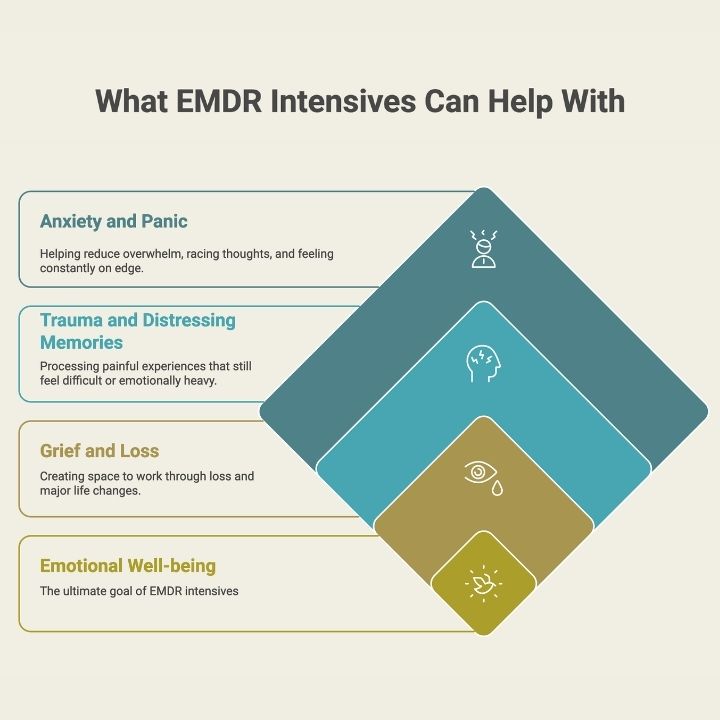
What EMDR Intensives can help with

EMDR intensives can support people carrying grief, anxiety, trauma, and emotional exhaustion. They create space to gently process painful experiences so the nervous system no longer feels stuck carrying them alone.

Grief and loss

Grief can stay with someone long after life around them has continued moving forward. Extended sessions can help people gently process painful losses, caregiving experiences, divorce, miscarriage, or other life changes that still feel deeply emotional.

Trauma and distressing memories

Some experiences continue affecting the nervous system years later. This approach can help people process distressing memories connected to trauma, painful relationships, childhood experiences, medical events, or moments that still feel difficult to revisit.

Anxiety and panic

Long periods of stress and emotional pressure can leave the mind and body feeling exhausted. Longer therapy sessions may help people struggling with anxiety, panic symptoms, racing thoughts, emotional overwhelm, or feeling constantly “on edge” throughout the day.

What to expect during an EMDR Intensive

EMDR intensives are designed to give people more time to settle into difficult emotions without feeling rushed through the process. Sessions often include grounding exercises, emotional processing, breaks for rest, and time to pause between heavier moments.

Some intensives last a half day, while others may take place across several days, depending on what someone hopes to work through. 

At Back Porch Counseling, the process is approached gently and thoughtfully. Clients are supported throughout the experience with space to pause, reflect, rest, and move through the work at a pace that feels emotionally safe.

Are EMDR Intensives right for you?

EMDR intensives may help people who feel emotionally overwhelmed, stuck, or exhausted by the ongoing pressure of daily life. They can also support professionals who struggle to fit weekly therapy into demanding schedules.

Some intensives last a half day, while others may take place across several days in a more peaceful setting outside the traditional office environment. 

Healing looks different for every person. Having dedicated space to pause, breathe, and process painful experiences can become an important step toward feeling more grounded and connected again.

Book EMDR Intensives in Huntsville, AL

Healing does not always happen well in rushed moments between meetings, responsibilities, and exhaustion. Sometimes it takes intentional space, steady support, and time to fully process what has been weighing on you.

EMDR intensives can provide a more focused and uninterrupted approach for professionals carrying grief, anxiety, trauma, or emotional exhaustion. Book a Free Consultation to learn if this approach feels like the right fit for you.

Frequently Asked Questions

Are EMDR intensives effective?

Yes, EMDR intensives can feel effective for people wanting more focused emotional processing in a shorter period of time. Longer sessions may help reduce the repeated stopping and restarting that can happen in traditional weekly therapy, especially for grief, trauma, anxiety, or burnout.

How long are EMDR intensives?

EMDR intensives can last from a half day to 2–5 consecutive days, depending on the level of support someone needs. Some people choose a single extended session, while others benefit from several days of more focused emotional processing.

What does an EMDR intensive look like?

EMDR intensives usually include grounding exercises, emotional processing, breaks for rest, and supportive guidance throughout the day. Sessions are often slower and more flexible than traditional therapy, allowing more time to settle into the work without feeling rushed.

Are EMDR intensives worth it?

EMDR intensives is worth considering for people who want a more focused and uninterrupted therapy experience. Some professionals prefer this format because it can fit better around demanding schedules while creating dedicated time away from daily stress and responsibilities.

Who is not a good fit for EMDR intensives?

EMDR intensives may not feel appropriate for people without enough emotional support, stability, or recovery time after sessions. A therapist will usually assess readiness beforehand to help determine if this approach feels emotionally safe and manageable for the client.

How Much Do EMDR Intensives Cost in Alabama?

What should you expect to pay for an EMDR intensive?

EMDR intensives in Alabama typically range from about $750 to $2,000 per day, depending on session length, number of days, and setting. It’s not always straightforward, especially when different approaches are involved.

At Back Porch Counseling, rates are outlined so you can see how the time is used and what is included. The structure should match what you are working through. Here’s what goes into that pricing.

What affects the cost of an EMDR intensive?

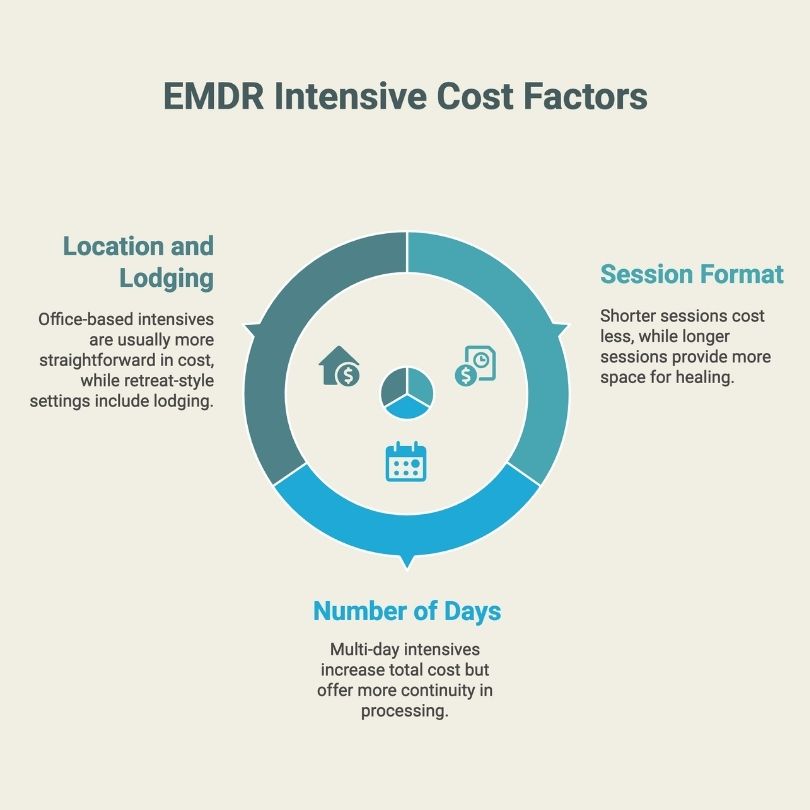
The cost of EMDR intensives is based on session length, number of days, and the setting where the work takes place. These factors shape how much time, support, and structure are included in the process.

Session format

Shorter sessions, such as half-day intensives, tend to cost less because there is less time available to move gently into the work and allow it to settle. Longer sessions create more space to stay with what comes up and support a more complete experience.

Number of days

Multi-day intensives increase total cost, though they also allow more continuity in processing without restarting each session.

Location and lodging

Office-based intensives are usually more straightforward in cost, while retreat-style settings include lodging. Being in a quieter space away from daily life can offer a sense of safety and room to focus on your own healing.

Half-day vs. full-day EMDR intensives

Half-day and full-day EMDR intensives are priced differently because they involve different levels of time, depth, and clinical support within the same day.

A half-day intensive, often around 3 hours, is about $750. This option is usually focused on one specific memory or experience, with enough time to prepare, begin processing, and come to a steady close. It can feel more contained when the work has a clear focus.

A full-day intensive, often 6 hours or more, is about $1,500 per day. This extended time allows for deeper processing, more continuity, and space to move through multiple layers without needing to pause and return later. It also includes more time for grounding, so the experience feels supported from beginning to end.

Office-based intensives vs. retreat-style intensives

Office-based EMDR intensives tend to follow the standard session rates, with the cost centered around the time spent in the work itself.

If you want more space away from daily life, retreat-style intensives can offer a different level of care. Being in a quieter setting can make it easier to stay engaged in the work without interruption.

Lodging, typically around $125 to $150 per night, along with travel, adds to the overall cost, but allows more room to rest and stay connected to the process.

What should be included in the price?

The price of an EMDR intensive should clearly reflect all costs involved, including session time, preparation, and any additional fees such as lodging.

  • Session rate: Cost per half-day or full-day intensive
  • Multi-day total: How pricing builds across consecutive days
  • Weekend rates: Adjusted pricing for weekend scheduling
  • Lodging: Staying on-site in a retreat setting, which allows you to remain in the same space throughout the work
  • Additional fees: Intake sessions, follow-up sessions, or required deposits

Clear pricing helps you understand the full financial commitment upfront, so there are no unexpected costs beyond the initial cost itself.

How Back Porch Counseling prices EMDR intensives

Back Porch Counseling prices EMDR intensives based on the amount of time set aside and the support needed for the work.

Half-day intensives are typically $750 on weekdays and $1,000 on weekends, while full-day intensives are $1,500 per day or $2,000 on weekends. This reflects the time reserved for you and the ability to stay with the process without interruption.

A 90-minute intake session is included to help prepare for the work, and a follow-up session can be scheduled if you would like continued support afterward. If you choose to stay in the retreat space, lodging is available as an additional cost so you can remain in the same environment during your time.

How to decide if the cost makes sense for you

The cost of an EMDR intensive can make more sense when you look at how it compares to ongoing weekly therapy and what you are receiving within that time.

An intensive has a higher upfront cost, though it also has a defined beginning and end. Weekly therapy spreads the cost out, but it can continue for several months without a clear total.

It can help to consider the overall cost across time. Weekly sessions can add up over several months, while an intensive brings that cost into a shorter, more focused period.

Looking at the total cost, the structure, and what feels manageable for you can help you decide if this approach fits your situation.

Importantly, beyond the financial side, this work can be an investment in your future, and the changes that come with it may influence how you experience your life and relationships.

Talk through EMDR intensive options in Alabama

Understanding the cost is part of deciding what kind of support fits what you are going through. Looking at how the time is structured and how the work can move can help you feel clearer about what you need right now.

Back Porch Counseling provides grief-focused counseling, certified EMDR therapy, and EMDR intensives, including retreat-style options near Huntsville and Lake Guntersville. The approach is to find a structure that supports the work and helps you stay with it in a way that feels grounded.

If you are thinking through this decision, you can Book a Free Consultation.

Frequently asked questions

How much does an EMDR intensive cost?

EMDR intensive cost depends on session length, number of days, and setting. Shorter sessions cost less, while multi-day or retreat-based intensives increase total cost due to extended time, continuity of care, and the ability to stay fully engaged in the work.

Is an EMDR intensive cheaper than weekly therapy?

An EMDR intensive can feel more cost-efficient when you consider how the work is concentrated. Instead of spreading sessions across months, intensives allow you to stay with the process continuously, which can reduce the overall length of treatment needed.

Does insurance cover EMDR intensives?

Insurance typically does not cover EMDR intensives. A superbill can be provided for possible out-of-network reimbursement, and checking directly with your insurance provider can help you understand what mental health benefits may apply.

Why do EMDR intensive prices vary so much?

EMDR intensive prices vary based on session length, number of days, therapist experience, and whether the work is done in an office or retreat setting. Additional elements like preparation time, follow-up support, and lodging can also influence the overall cost.

Can EMDR intensives be done online?

EMDR intensives can be done online when the setup allows for privacy, stability, and focused engagement. Virtual formats can still support continuous processing, though some people prefer in-person or retreat settings for fewer distractions and a more contained experience.

7 Signs You’d Benefit From EMDR Intensives in Alabama

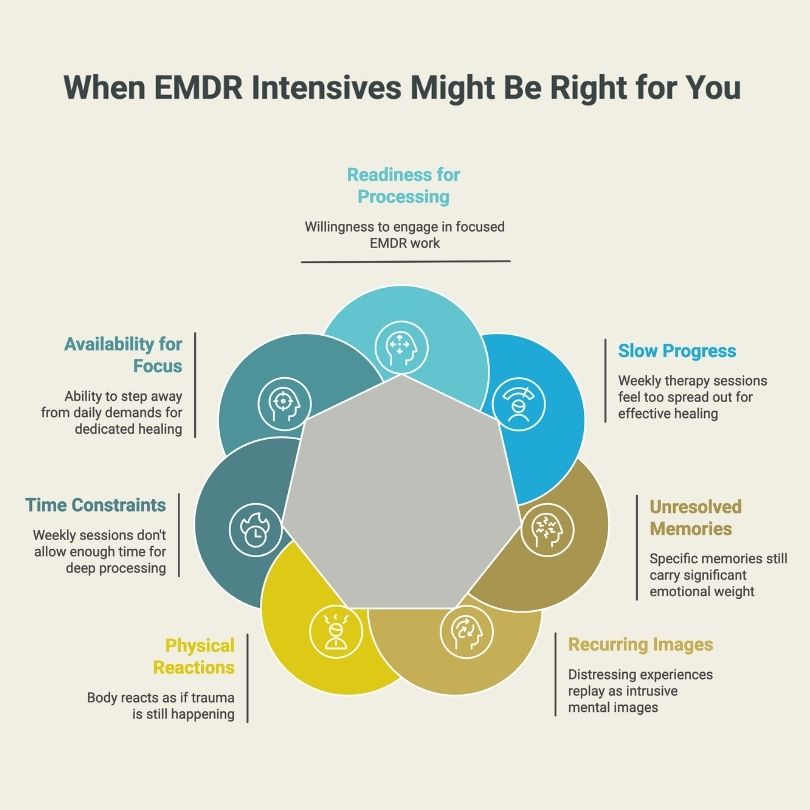
How do you know when weekly therapy is no longer enough for what you are working through? It often shows up as slow or interrupted progress, where sessions feel too far apart or unfinished before the work can fully settle.

EMDR intensives are extended sessions delivered over a concentrated period of time instead of weekly 50-minute appointments. This approach can help when deeper processing is needed for grief, trauma, or distressing memories, especially when weekly therapy starts to feel too spread out.

This does not mean EMDR therapy is not helping. It may point to a need for a more focused structure, especially for those seeking care in Alabama. Here are the signs you’d benefit from EMDR intensives.

1. Weekly therapy feels too spread out for the work you need

When there are several days between sessions, it can be harder to stay connected to the progress you started.

You might begin to open something important in one session, then return to daily life before it has been fully processed. By the time the next session comes, the momentum can feel lost, and you may need to spend time finding your way back to the same place.

An EMDR intensive allows you to stay with the same memory or experience for several hours in a single day, so the work can move forward without being interrupted or paused in the middle. Research suggests this continuity can support stronger engagement than weekly sessions.

2. You know which memories still feel unresolved

You may benefit from EMDR intensives if you can clearly identify memories that still carry emotional weight.

You might think about a particular conversation, event, or loss and notice that the feeling does not settle the way you expect. Even after time has passed, the memory still feels unfinished or heavier than it should.

EMDR intensives stay focused on that identified memory long enough for your brain to process it more fully, so it begins to feel more settled and less emotionally charged when you think about it.

3. A loss or trauma keeps replaying in specific images or moments

Recurring images or mental loops are a common sign that your brain has not fully processed a distressing experience.

You might suddenly see a specific image, hear words in your mind, or feel pulled back into a moment without warning. These experiences can happen several times a week or even within the same day, especially when something reminds you of it.

EMDR intensives create space to process these images in longer sessions, helping reduce their frequency and emotional charge.

4. Your body still reacts like the event is happening now

Physical reactions to past experiences can indicate that trauma is still stored in the body.

A reminder can lead to a rapid heartbeat, muscle tension, or a sudden sense of panic that lasts for several minutes. These reactions can feel out of proportion to what is happening in the moment.

EMDR intensives help your nervous system process these stuck responses so your body no longer reacts as if the danger is still happening. Studies show EMDR can lower emotional distress and change how the memory is stored, helping the body recognize safety again.

5. You need more time than a weekly session allows

Some therapeutic work requires extended time to feel complete within a single session.

In a standard 50-minute appointment, it can be difficult to fully access, process, and stabilize after engaging with difficult material. This can leave sessions feeling unfinished or emotionally open.

EMDR intensives typically provide 3 to 6 hours of structured therapy per day, allowing time for preparation, processing, and grounding within the same session. 

6. You can step away from daily demands for deeper work

EMDR intensives require a temporary pause from daily responsibilities to allow focused healing.

Many intensive formats take place over 2 to 5 consecutive days, which means stepping away from work, roles, or daily routines. This dedicated time allows you to stay engaged in the process without the usual interruptions that can pull your attention away.

EMDR intensives can also be done as a retreat away from your everyday environment, creating a separate space where you can focus fully on the work without ongoing demands or distractions.

7. You feel ready to prepare for focused EMDR processing

Readiness is one of the most important indicators that an EMDR intensive may be appropriate.

This does not mean feeling fully confident or without hesitation. It often means recognizing that something needs attention and feeling open to working through it with support.

EMDR intensives include preparation as part of the process, helping you build enough stability before moving into deeper work so the experience feels supported, contained, and manageable as you move through it.

Talk through EMDR intensive options in Alabama

If several of these signs feel familiar, it may reflect that your current pace of therapy is not matching the depth of what needs to be processed.

EMDR intensives provide a structured way to stay with the work long enough for more complete processing, through extended sessions or a focused retreat away from daily demands. This approach can support deeper shifts in a shorter period of time, especially when specific memories or reactions continue to feel unresolved.

If you’re ready to take that next step, Book a Free Consultation to talk through your options.

Frequently asked questions

How long is an EMDR intensive?

An EMDR intensive typically runs over 2 to 5 consecutive days or as extended sessions across a shorter timeframe. The structure is designed to maintain continuity, allowing deeper processing without the repeated stopping points that can slow progress in weekly therapy.

Can EMDR intensives be done online?

Yes, EMDR intensives can be done online when appropriate and clinically safe. Virtual formats use guided bilateral stimulation and structured support, allowing you to engage in focused processing from home while still maintaining the depth and continuity needed for intensive work.

How much is an EMDR intensive?

The cost depends on the length, structure, and level of support included. Multi-day intensives are higher than standard sessions due to the extended, focused work. In the long run, intensives can be more cost-effective because the therapy is concentrated and highly focused.

Does insurance cover EMDR intensives?

EMDR intensives are not covered by insurance. A superbill can be provided for possible out-of-network reimbursement, depending on your plan. It is recommended to contact your insurance provider directly to confirm any available mental health benefits.

EMDR Intensives vs EMDR Therapy

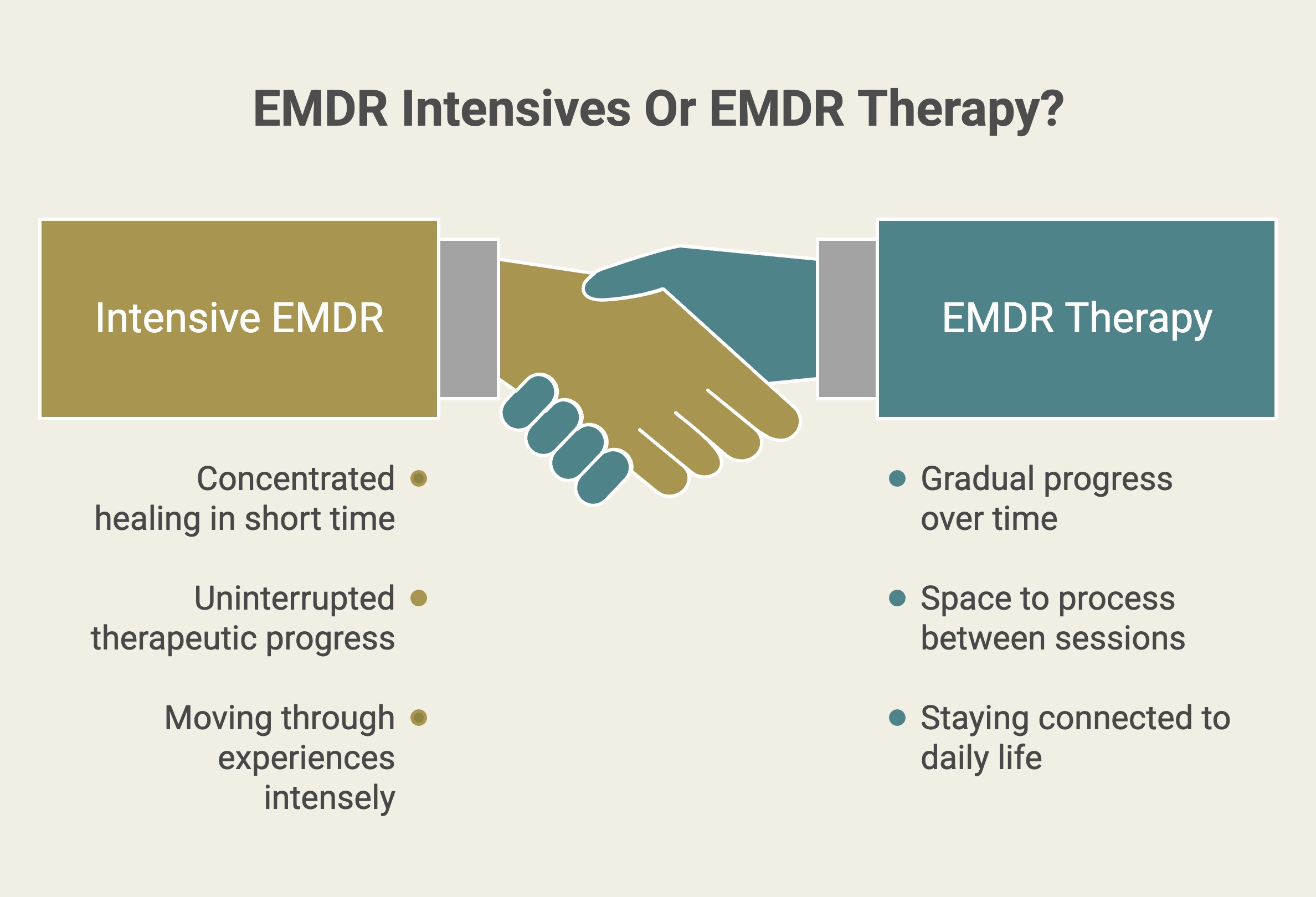
EMDR intensives and EMDR therapy offer two ways of working through the same process, with the main difference being how the time is structured. One brings longer, focused sessions, while the other moves at a steady weekly pace.

You might find yourself wondering which approach feels right. Is it better to stay with the work in a shorter, concentrated period, or to move through it gradually over time?

There isn’t a right or wrong choice. What tends to matter more is what feels sustainable, supportive, and aligned with how you want to move through the process.

This guide walks through how EMDR intensives and weekly sessions compare, and how to choose the approach that fits you best.

What are EMDR intensives?

EMDR intensives are extended EMDR sessions designed to help process trauma in a shorter, more concentrated period of time.

Structure

Sessions typically involve working together for about 6 hours a day across 2 to 5 days. They often begin in the morning and continue through the afternoon with breaks as needed, allowing the work to stay continuous.

In many intensive formats, the work centers on one memory at a time, often focusing on working through memories from more complex trauma for the day so it can be processed with more focus and attention.

Benefits

EMDR intensives can help in a few important ways:

  • More time is spent processing, rather than reopening things each session
  • More can be worked through in a shorter period of time
  • Greater sense of safety as the client deals with more traumatic memories and doesn’t have to drive home or deal with every day responsibilities
  • Less interruption between sessions, which can help you stay with the process
  • Fewer sessions may be needed overall
  • Space to rest and reflect between longer sessions

This can make the work feel steadier and easier to stay connected to from one session to the next.

Who it is best for

EMDR intensives are especially helpful for people working through complex or layered trauma, including long-standing grief, relational wounds, or experiences that don’t trace back to a single event . Intensives are also best for those who prefer to work through things in a more concentrated way. 

They are also a good fit for those who want to step away from their daily routine and fully focus on their healing for a short period of time.

Costs

Costs are structured per day. A half-day intensive is typically around $750 on weekdays and $1,000 on weekends. Full-day sessions are about $1,500 per day or $2,000 on weekends. Lodging at the retreat space is available at approximately $125 per night.

What do EMDR sessions look like?

EMDR sessions follow a steady, guided process where you focus on specific memories while staying grounded and supported throughout.

Structure

Sessions typically last 50 to 90 minutes and take place once a week. Time is spent identifying what you want to work on, building stability, and then using bilateral stimulation, such as eye movement, tapping, or sound, while briefly focusing on parts of a memory.

Benefits

Meeting regularly in shorter sessions allows for:

  • A steady pace that gives you time to adjust between sessions
  • Space to reflect on what comes up outside of therapy
  • Support while working through more complex or layered experiences
  • Integration of changes into daily life over time
  • Flexibility to move forward at a comfortable rhythm

This approach allows the work to build gradually, with time between sessions to process and settle.

Who this is best for

EMDR therapy is often a good fit for individuals who prefer a slower pace. . It can also be helpful when ongoing support is needed alongside day-to-day responsibilities.

Costs

Sessions are typically paid per visit and may range from $160 to $240, depending on the length of the session. A superbill may be provided if you plan to seek out-of-network reimbursement.

Deciding which one is best for you

EMDR intensives are best when you want to focus deeply in a shorter period of time, while weekly EMDR sessions are better when you prefer a steady pace with time between sessions.

Intensives are a better fit if you want to stay with the work without stopping and restarting each week. They can be helpful when you want to move through traumatic experiences in a more concentrated way.

Weekly EMDR therapy sessions are a better fit if you want time between sessions to reflect and adjust. This can be helpful when you need to stay connected to your daily routine while in therapy.

The decision often comes down to what feels realistic for you right now, both in terms of time and how you want to move through the process.

Find your way forward at Back Porch Counseling

There is not one way this work has to look. Both EMDR intensives and weekly EMDR therapy can be helpful, depending on what feels right for you and where you are right now.

You may find that one approach fits better than the other, or that your needs shift. What matters most is having a place to begin, and a way to work through what has been difficult in a way that feels steady and supported.

If you are unsure which option makes sense for you, we can take the time to talk it through together and find what feels like the right next step. Book a free consultation.

Frequently asked questions

Do EMDR intensives work?

Yes, EMDR intensives can help you work through trauma more quickly by staying with the process for longer periods of time. This focused approach allows your mind to process more without having to pause between sessions. Research shows they are just as effective as weekly sessions and relief is often felt sooner with intensives. Additionally, because of the sense of safety felt in a retreat setting, you may be able to go into deeper memories with greater ease.

How to prepare for EMDR intensive?

Preparation involves getting clear on what you would like to work on and making space in your schedule to focus on the process. It can also help to plan for rest, since the work can feel both meaningful and tiring.

How many sessions of EDMR to see results?

Some people notice changes within a few sessions, while others may need more time, depending on what they are working through. The pace can vary, but the focus is on allowing things to shift in a way that feels steady.

Is EMDR intensive better than weekly therapy?

EMDR intensives are not better, it’s just different in how the work is paced. Some people prefer staying with the process in longer sessions, while others benefit from having time between weekly sessions.

Can EMDR help if I don’t remember everything clearly?

Yes, EMDR can still be helpful even if parts of the memory feel unclear or incomplete. The process does not rely on full recall, but on how the experience is held in your mind and body.

Creative Ideas to Remember Your Loved One

One of the most important things that a bereaved individual can do to help them as they grieve is to express their grief in mourning rituals and activities. I think this is true because it gives voice and form to our feelings of loss and helps us take concrete steps in remembering and honoring our loved ones. In other words, it helps us put our grief into action. We all are different and, therefore, different ways to memorialize and remember our loved one will appeal to us or be meaningful to us. Below are a variety of things we can do to help us memorialize or honor our loved one’s memory. The only limit is your creativity!

Memorial Ideas:

  1. Keep a memory journal. As you think of happy memories, write a few lines about what made that a special moment. You may even want to add photos. 
  2. Make a scrapbook or photo album or frame/shadow box special memories. You could hang their favorite verse, saying, or poem on the wall as well. 
  3. Memorial jewelry can be made out of wedding rings or you may simply want to wear your loved one’s favorite piece of jewelry. Lockets with photos or locks of hair can also be meaningful.
  4. Use your loved one’s clothing to make or have made pillow covers, quilts, or teddy bears. Ties, t-shirts, and shirts can all be used. 
  5. Many types of gifts can be made utilizing your loved one’s handwriting – pillow shams, jewelry, wall hangings, for example. There are many ideas for these items on Etsy.
  6. Many people find it meaningful to design and get a memorial tattoo.
  7. Starting a foundation, event, or scholarship in your loved one’s memory
  8. Plant a memorial garden, or add special paving/stepping stones to the yard or maybe plant a tree in your loved one’s memory.
  9. Many things can be made with ashes of a loved one – jewelry, paperweights, and Christmas ornaments are examples. 
  10. Make a memorial Christmas ornament. 
  11. Memorial artwork – either create your own or have one commissioned. 
  12. Create a book – of recipes or family stories, perhaps.
  13. Do an act of kindness or charity on your loved one’s birthday or death anniversary – in their honor. 
  14. Finish a project your loved one was working on – or do one you feel your loved one would have been proud of. 
  15. Host a memorial celebration at a later date with close friends and family.
  16. Watch your loved one’s favorite movie, or read their favorite book, or play a game they enjoyed, eat their favorite meal or dessert, and remember them with joy.
  17. You may find it comforting to wear a piece of your loved one’s clothing – a t-shirt or tie, perhaps. 
  18. Create a tribute video of favorite photos, quotes, memories. 
  19. Take a trip or have an adventure your loved one always wanted to experience.
  20. On their birthday eat their favorite food, or on a family holiday, make some dish they loved.

Other ideas are online at Etsy and on Pinterest. Craft supplies are available at Hobby Lobby. Be creative and do something meaningful to you! Have you done anything creative and meaningful as you remember your loved one? Please share your ideas in the comments. 

A Blessing For Those Who Grieve

I was inspired to write this by the many loss survivors I spend time with each week. Jesus said, in scripture, “Blessed are those who mourn, for they shall be comforted.” In light of his words, I have written this blessing for my friends who grieve…

A Blessing for Those Who Grieve

Blessed are those who unexpectedly cry in the grocery store, while driving down the road in their car, or when they awake in the morning, for their hearts are tender and they have loved deeply.

Blessed are those who have endured the unendurable, faced the unthinkable, and are still standing, for they have strength.

Blessed are those who question, who seek, who dare ask why, who wail and scream, for they are honest about what they feel.

Blessed are those who have had to say good-bye too soon for they know that life is precious and sometimes far too short.

Blessed are those who have regrets, who have failed, who feel guilty, for they know that relationships are sometimes messy and this is what it is to be human. May they know peace.

Blessed are those who feel abandoned, who are judged, who sit alone and wonder where everyone has gone, for they know the true value of faithful friendship.

Blessed are those who tell their story again and again and again…to sales clerks, to strangers in line at Wal-Mart, to unsuspecting people who ask how they are doing, because it is just so hard to believe it is real, for they know the great gift of simple human kindness and a listening ear.

Blessed are those who can no longer hold their loved ones physically, but continue to hold them within their hearts, for they hold a bit of eternity.

Blessed are those who lay awake at 2 am, exhausted by life and yet unable to sleep, may they find rest.

Blessed are those attempting to build a new life without a set of blueprints or an instruction manual, may they have clarity and a vision for the future.

Blessed are those who are now traveling in totally alien territory, with no clear path before them. May they find purpose and meaning.

Blessed are those who feel broken apart, unable to put themselves together again, for they know how much we all need compassion.

Blessed are those learning to carry a reality that cannot be resolved or fixed for they understand that all problems do not have solutions.

Blessed are those who have fallen down, sitting in the ashes of their former lives, for they have crawled, they have stood back up…over and over and over. They are courageous and learning to begin again.

Blessed are those who have experienced deep loss and deep grief. May hope, light, life, and comfort dawn upon their souls as they continue to walk forward.

– Jan Owen
July 2019